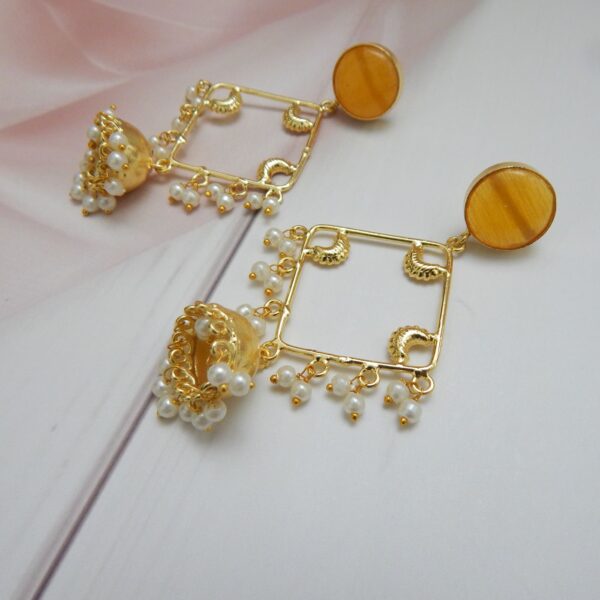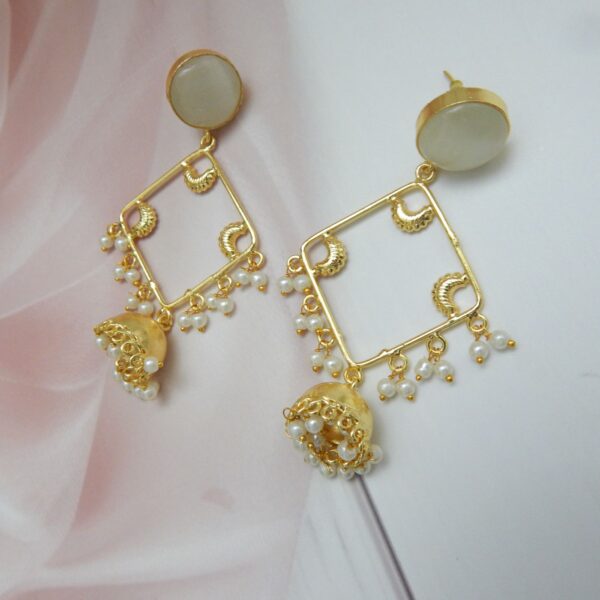

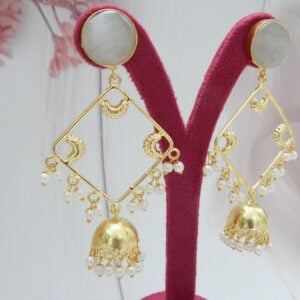
These geometric jhumka earrings bring a modern shape to one of India’s most loved earring styles. A round stone stud sits at the earlobe, leading into an open square frame set on its corner like a diamond. Inside the frame, textured crescent motifs add a traditional touch, while pearl drops hang along its lower edges. At the very bottom, a gold-toned jhumka fringed with pearls completes the look. Choose from two shades: milky white and mustard yellow.
Why These Geometric Jhumka Earrings Stand Out
Most jhumkas follow a familiar pattern — a stud, a dome and a few pearls. The geometric jhumka earrings keep everything you love about the classic jhumka and place it inside a clean, open square frame. The result feels fresh and contemporary without losing its ethnic charm.
The open frame keeps the design airy, so the earrings look bold without feeling heavy on the eye. The pearl drops move with every turn of your head, and the pearl-fringed jhumka adds that familiar, festive swing. These pearl jhumka earrings strike a balance that suits both the office and the celebration.
Two shades, one versatile design
- Milky white: a soft, opaque white stone that pairs with pastels, whites, black, maroon, navy and bright festive colours alike.
- Mustard yellow: a warm, honey-toned stone that pairs with white, cream, green, blue, maroon and earthy prints.
Both shades of these geometric jhumka earrings work equally well for daily wear, office wear, parties and festive dressing. Choose the colour that suits your wardrobe best.
From Monday meetings to festive evenings
These square jhumka earrings move easily between the different parts of your week:
- At work: pair them with a straight kurta, a printed co-ord set or a solid shirt dress for a polished look with a touch of ethnic personality.
- Weekend plans: wear them with a white top and denims or a casual cotton dress for an easy Indo-western twist.
- Festive season: team them with a chaniya choli, a silk saree or an Anarkali during Navratri, Diwali and wedding functions.
- Parties and get-togethers: style them with a simple kurta set or a saree and let the jhumka do the talking — no heavy necklace needed.
If you are looking for jhumka earrings for kurti looks that feel a little different from the usual, this design adds shape, movement and colour in one pair.
The earring has always been one of the quickest ways to change the mood of an outfit, and the jhumka remains one of India’s most recognisable styles. For more designs in the same spirit, explore our full jhumka earrings collection.
Caring for your geometric jhumka earrings
- Put your earrings on after perfume, hairspray and makeup, and take them off before bathing, swimming or exercise.
- Wipe the stone, frame and pearls gently with a soft, dry cloth after each wear.
- Store each pair flat and separately in a zip pouch or lined box, so the pearl drops don’t tangle or bend.
- Keep them away from moisture to protect the gold-toned finish.
Frequently Asked Questions
Kya ye jhumka earrings office mein pehen sakte hain?
Yes. The open frame keeps the design light-looking, so both shades suit office wear with kurtas and co-ord sets, while still looking festive enough for celebrations.
Earrings ki care kaise karein taaki finish lambe time tak rahe?
Keep them away from water, perfume and sweat. Wipe them with a soft, dry cloth after use, and store each pair flat in an airtight pouch so the pearl drops stay untangled.
Milky white aur mustard yellow mein se kaunsa choose karein?
Choose by your wardrobe. Milky white suits pastels, whites and deep colours, while mustard yellow suits whites, greens, blues and earthy prints. Both shades work for daily, office and festive wear.
Geometric jhumka earrings kya hote hain?
Geometric jhumka earrings combine a traditional bell-shaped jhumka with a modern geometric element, such as a square, triangle or hexagon frame. They offer the familiar swing of a classic jhumka with a more contemporary, structured silhouette.
Jhumka aur chandbali earrings mein kya difference hai?
A jhumka ends in a bell-shaped dome that hangs below the ear. A chandbali is shaped like a crescent moon, usually flat and open. Jhumkas have more movement and volume, while chandbalis have a flatter, more ornate profile.